Known for a unique and highly colourful signature approach to painting, Gershon Iskowitz (1919–1988) was one of the most celebrated artists in Canada in the twentieth century. Learn more about his remarkable life and how he created his own approach to Canadian landscapes in Glenbow’s latest artist profile.
Gershon Iskowitz grew up in one of the most tumultuous periods of world history. He was born in Kielce, a city in Poland, and his family was part of the vibrant Jewish community—his father was a writer for Yiddish newspapers. Iskowitz grew up determined to be an artist. He planned to begin his studies at the Academy of Fine Arts in Warsaw in autumn 1939, but the Nazi invasion of Poland made this impossible. Iskowitz and his family were forced to live in the Kielce Ghetto; then, in 1942, they were sent to camps. Several members of the family were murdered at the Treblinka extermination camp, but Iskowitz was sent to the Henryków labour camp and then to the Auschwitz concentration camp. In the last months of the war, he was one of several thousand prisoners forced to evacuate from the camp through death marches. He ended up at the Buchenwald concentration camp in Germany, which was liberated by the American army in April 1945.
In the aftermath of the war, Iskowitz was hospitalized for several months and then moved to the Feldafing Displaced Persons Camp in Germany. He is believed to have lived there until 1948, when he immigrated to Canada. He had an uncle and extended family in Toronto, Ontario, and they helped him settle in the city. He met the artist Yehuda Podeswa, also a Holocaust survivor, while travelling to Canada, and together they began learning about the art community in Toronto, attending classes, and meeting other artists. In the early 1950s, artist societies across Canada were very active in organizing exhibition opportunities, and in 1954 Iskowitz submitted his work to the annual exhibition of the Canadian Society of Graphic Art. Within a few years, he was showing his work in commercial galleries in Toronto.
Early in his career, Iskowitz was known for landscape paintings with dramatic arrangements of forms that were nearly abstract in effect: his colours and shapes were inspired by places, but they were often nearly unrecognizable. He was quickly admired for his interpretation of landscape in Canada: discussing his work in 1960, critic Colin Sabiston said, “Each picture is a sonnet in paint—a poet-painter’s love poem to the spacious freedom of Canada’s land, waterways and skies.”[1]
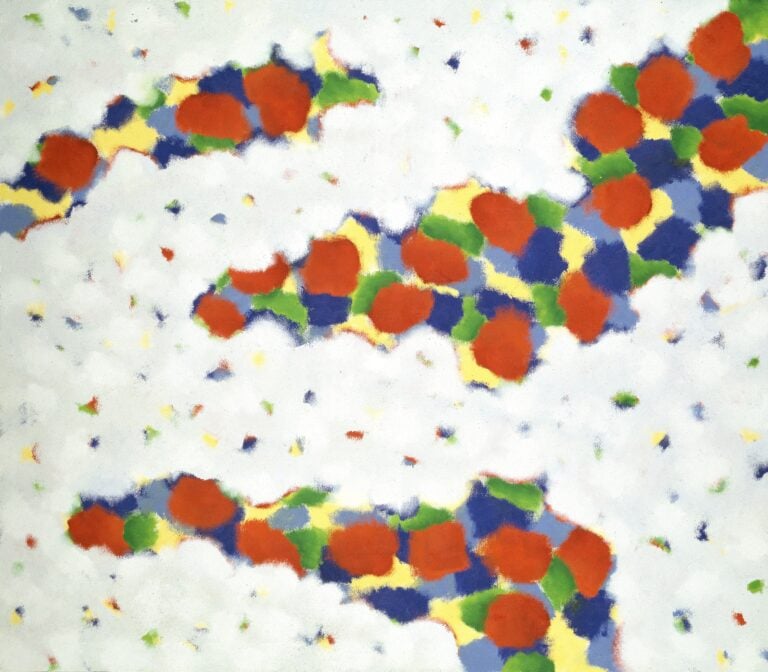
Gradually, his work moved closer to abstraction, though he emphasized that he remained inspired by what he saw. In 1966, he began working with simplified oval forms: as he explained, “In 1966, when I painted the summer, spring, and autumn…I was painting the landscape looking up through the trees; but in 1967 everything was falling down. The leaves were falling down.”[2] Later in 1967, he received a grant from the Canada Council and made a trip that changed his life. He hired a helicopter to fly him from Winnipeg, Manitoba to Churchill, Manitoba and around the Churchill area, and he was fascinated with the aerial perspective. As his biographer Adele Freedman explains, “He saw bright colours exploding through layers of cloud, land masses breaking through atmospheric barriers, dramas enacted on epic scale by the protagonists—space, form, and colour.”[3] He later made additional trips to James Bay (the southernmost part of Hudson Bay) and Yellowknife, Northwest Territories, and these experiences would inspire numerous paintings, many of which focus on his distinctive oval forms, as can be seen in Red D, 1979.
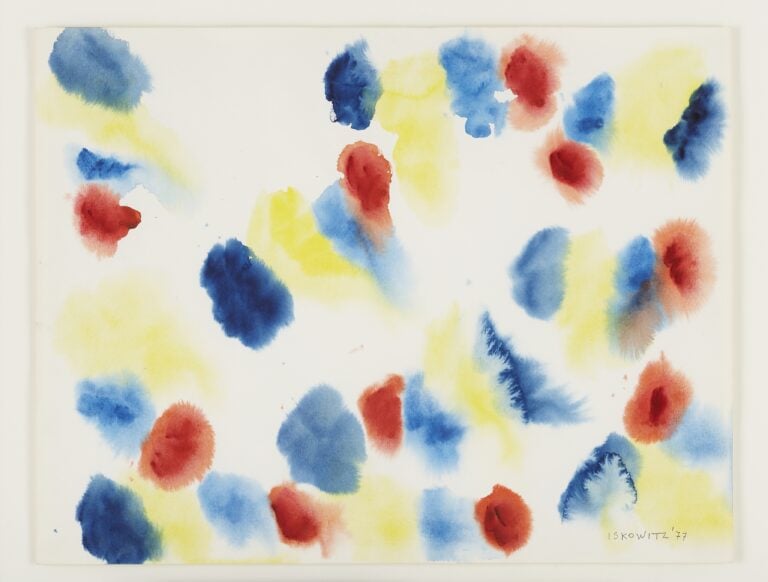
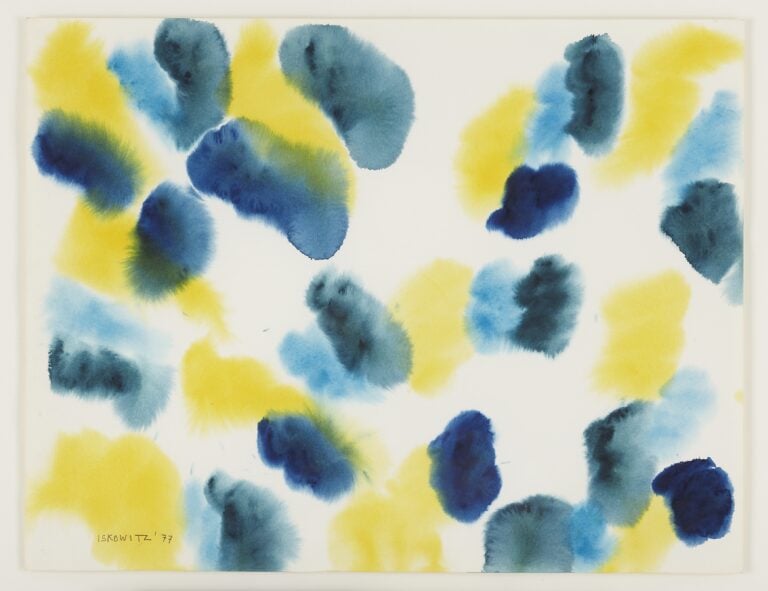
Iskowitz’s new approach also gave him more opportunities to experiment with colour. In 1977, for example, he began a new series of watercolours, which includes Untitled and Untitled, seen below. Curator Ihor Holubizky noted the fluidity in these works was only achieved through great care: “He made this series by dropping paint onto dampened paper, creating ovoid blips and clusters of selected colours that float in ethereal groups on a neutral background. This process was careful and measured, to avoid overbleed (losing the shape) or muddying the strong chromatic patches. Whether lighter blue, green, and yellow…or vivid reds, blues, and greens…, they are jewel-like in their clarity and transparency and appear to move and flutter on the paper.”[4] These remarkable achievements in colour—which he also achieved in oil paint—led to greater recognition for Iskowitz’s art. He represented Canada at the Venice Biennale in 1972, and his work was shown in several museum exhibitions. One of the earliest was held at Glenbow in 1975; on that occasion, Iskowitz proudly explained, “When I paint, I’m great, I feel great. Under any circumstances, anywhere I lived, anywhere I studied, I expressed myself. I lived in Poland, I painted those paintings. I lived in Germany, I painted. I’m living in Canada, I’ve got to paint Canada. In Canada…I think the land is very beautiful.”[5]
Today, Iskowitz’s legacy goes far beyond his paintings. Late in life, he decided he wanted to give back to the artistic community in Canada and in 1985, he established the Gershon Iskowitz Foundation. He founded it with the goal of supporting artists, saying, “It’s very important to give something so the next generation can really believe in something. I think the artist works for himself for the most part. Every artist goes through stages of fear and love or whatever it is and has to fight day after day to survive like everyone else. Art is a form of satisfying yourself and satisfying others. We want to be good and belong. That goes through history; we’re striving for it.”[6] The Foundation’s main focus has been to present the Gershon Iskowitz Prize, an annual award for Canadian artists that has become one of the country’s highest artistic honours and a lasting testament to Iskowitz’s commitment to art in Canada.
References
[1] Colin Sabiston, “Iskowitz: Sonnets in Paint,” The Globe and Mail, March 12, 1960, 15.
[2] Adele Freedman, Gershon Iskowitz: Painter of Light (Toronto: Merritt Publishing Company, 1982), 113.
[3] Freedman, Gershon Iskowitz, 113.
[4] Ihor Holubizky, Gershon Iskowitz: Life & Work (Toronto: Art Canada Institute, 2019), 46.
[5] “Iskowitz at the Glenbow: Art as joy and celebration of life,” The Calgary Albertan, May 24, 1975, 9.
[6] Gershon Iskowitz Foundation, https://iskowitzfoundation.ca/.
