When Glenbow reopens in its revitalized home, the JR Shaw Centre for Arts & Culture, visitors will experience compelling new displays co-created with members of Calgary’s Mexican, Ethiopian, and Indonesian communities. These displays highlight the diversity of collections in Glenbow’s care and reflect the museum’s commitment to telling meaningful, community-driven stories. Each group of co-curators has worked closely with Glenbow’s team to select art, objects, and belongings that represent and celebrate their cultural heritage.
Members of the Mexican community in Calgary including Patricia Campos Díaz, Claudia Chagoya, Jimena Guerra, Mera Reyes, Ximena Ríos, and Almendra Vergara came together to select objects ranging from Pre-Hispanic phytomorphic and zoomorphic vessels (vessels shaped like plants and animals made before the arrival of Spanish colonizers in the 16th century) to spindle whorls (weights used to spin fibres into thread) to a huipil (a traditional Indigenous garment worn by women).
In celebration of Latin American Heritage Month, Patricia Campos Díaz – one of the display’s co-curators and Glenbow’s Assistant Conservator, Objects – spoke with us about the curatorial process, her work at Glenbow, and what she’s most looking forward to about the display.
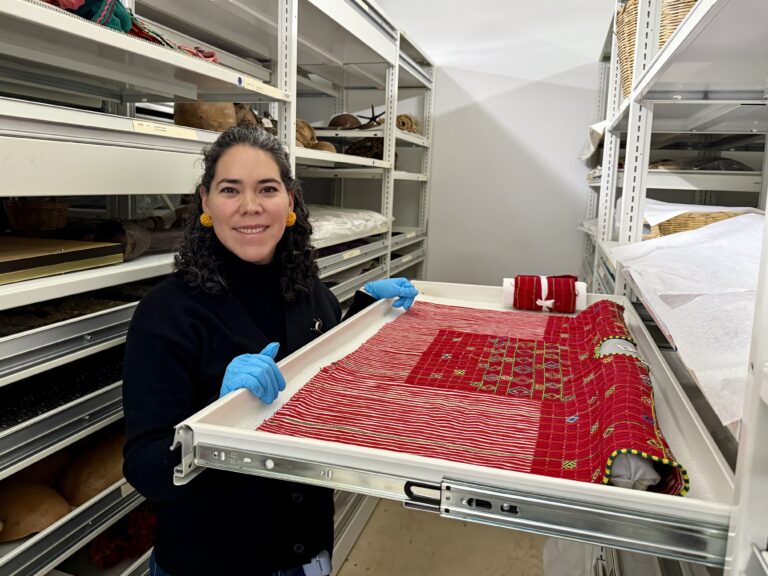
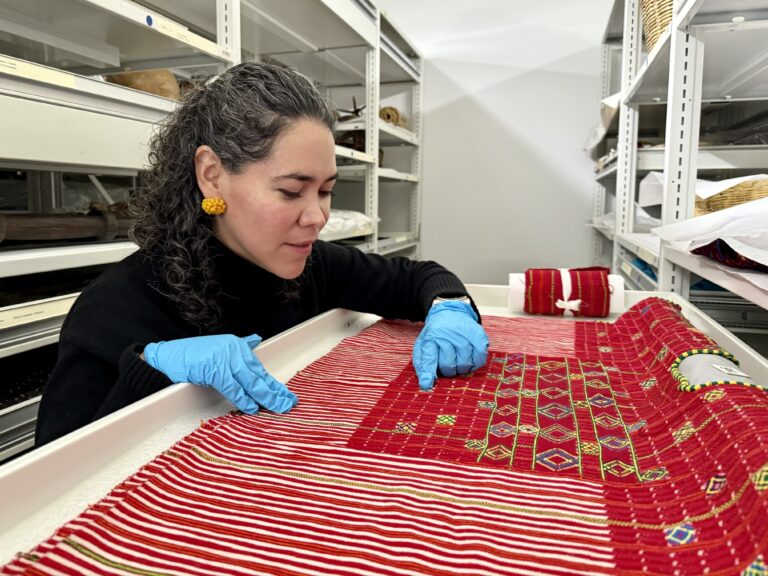
Hello, Patricia! Tell us a bit about yourself and how you got involved with planning the Mexican community display.
Hi! Thank you for having me. I began working with the team planning the Mexican community display in 2024 and joined Glenbow as Assistant Conservator, Objects in spring 2026.
I’m a conservator trained in México, and I also hold an MBA. Back home, I had the opportunity to work at incredible archaeological sites and with communities, museums, and universities. I helped conserve a wide range of objects, from Pre-Hispanic artifacts, to paintings, sculpture, metalwork, books, and textiles spanning the 16th to 20th centuries, to contemporary works of art.
Before coming to Canada, I was Deputy Director of the National School of Conservation, Restoration and Museography (ENCRyM) in México City, the first school of conservation in Latin America and one of the most respected. Eventually, I decided to follow my dream of doing a PhD, which is what brought me to the University of Calgary, where I’m now in the final stages of a PhD in archaeology. It was there that Dr. Kathryn Reese-Taylor, a dear professor of mine, introduced me to the other members of the team planning the Mexican community display, and they invited me to join them.
In addition to your work on the display, you’re also Glenbow’s Assistant Conservator, Objects. What has it been like to bring your perspectives as a conservator and a member of the Mexican community in Calgary together?
It has been an amazing experience. I still remember sitting across the street from Glenbow with a coffee, shortly after we arrived in Calgary, telling my family how much I wanted to work there. I was so disappointed that I hadn’t been able to visit before the museum closed to renovate, just one week after we arrived! Then the position opened up, I applied, and I feel so fortunate to be part of Glenbow at such an important moment.
Working with people from so many different backgrounds is incredibly enriching. I’m constantly learning, and I also get to share some of my own knowledge. Glenbow is the perfect place for me: I can put my conservation expertise into practice and bring my Mexican identity with me, sharing a bit of our treasured past and present with the wider Calgary community.
As an immigrant, I know how important it is to have a place where you can find pieces of your past, a place you can relate to, and a place where others can learn about your culture. I feel very privileged to help bring that to the Mexican community. I also know how much material culture means to humanity, so caring for these objects is both a great responsibility and an honour, not only for the Mexican community but for every community whose belongings are stewarded by Glenbow.
What are you and your fellow community members hoping to share about Mexican culture and heritage through this display?
I feel lucky to work alongside such a wonderful team of knowledgeable, strong women. We care deeply about our Mexican identity and are proud of it, and that’s something we hope visitors will feel, too. We want to show a bit of the greatness of México’s past: the complexity of the Mesoamerican societies that existed before the arrival of Spanish colonizers in the 16th century, and how many of those societies’ traditions have survived to this day.
It’s also important to us to challenge misconceptions and prejudices about Mexican identity, and what better way to do that than through objects we cherish? We were fortunate that Glenbow cares for an important collection of Pre-Hispanic objects – items that hold deep meaning for the Mexican people and that we are now able to share with Calgary.
Why is it important for members of the Mexican community in Calgary to have a voice in how their culture and heritage are represented in the display?
That’s such an important question, and I’m so glad to be part of how Glenbow is making space for these voices. The way I see it, museums safeguard history and stories through material culture. Historically, those stories were told only from the perspective of people inside the museum, or people with particular credentials. As a result, many stories went untold or were told very differently from how the people connected to them would tell them.
Museums have historically been colonial institutions, with the power to decide which stories were shared and how they were told. Today, I see real change in how some museums work. They understand they are not only keepers of artifacts and stories, but that they have the responsibility to truly understand the collections in their care. That means listening to the communities those collections come from. Letting people tell their own stories is an essential part of decolonizing museums, and Glenbow is doing meaningful work in this area.
How did you decide which objects from Glenbow’s collection to include? Were there particular stories you wanted to tell?
This took us so much time and so many conversations because we wanted to make sure we chose objects that were powerful in sharing our message. As in any curatorial work, choosing the right objects is always very challenging, because there are so many you might personally like but that may not be best to share your ideas. We wanted to make sure we chose objects that had a lot of meaning and showed how complex societies were, how México still has so much of this knowledge in its present, and how this knowledge shapes Mexican identity now.
As a conservator, you work to care for and preserve objects in Glenbow’s collections. Does your conservation background influence how you approach objects and their stories?
Absolutely! Conservation has been such a central part of my life that it’s hard to separate it from who I am. For me, the work goes beyond the material side of an object to the why of preservation. Why are these objects important, and to whom? Does everyone understand them in the same way? And how can our conservation treatments honour those different meanings? I’m deeply committed to understanding objects as holders of history and stories.
These questions are at the heart of my PhD research, which explores the different ways Indigenous Peoples understand heritage and how conservation can respectfully embrace those meanings. In México, this is part of our practice: conservators often draw on ancestral knowledge of materials. Working this way honours Indigenous knowledge while also bringing stable, compatible materials into our treatments.
Is there an object in the display that holds special meaning for you personally?
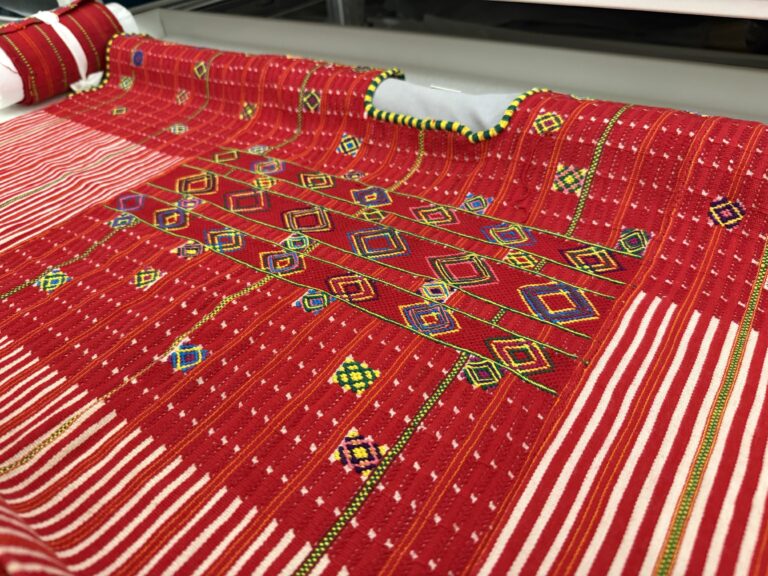
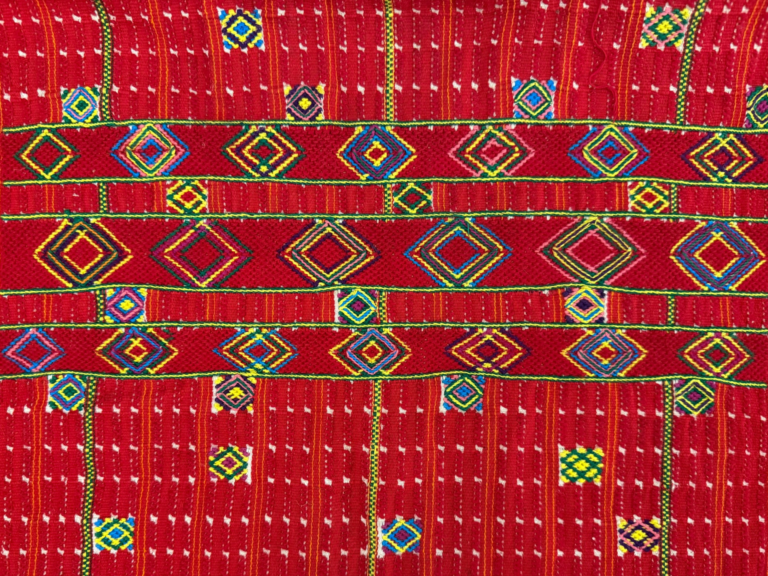
For me, the textile is at the heart of the display. México and Guatemala share a rich weaving tradition that goes back more than 4,000 years, long before the arrival of the Spanish, and has been passed down through generations. Each culture has its own distinct colours, designs, and materials. Many communities still use natural dyes that have been part of this tradition for centuries. To name just a few: grana cochinilla (cochineal insect) for reds, añil (indigo) for blues, caracol púrpura pansa (purple sea snail) for purples, pericón (Mexican tarragon) and cempasúchil (marigold) for yellows, and palo de Campeche (logwood) for greys and blacks. Cochineal in particular became one of New Spain’s most valuable exports during the colonial period. It was used extensively to dye European textiles and brought major economic changes to the region.
As in many textile traditions, this knowledge has been passed from mothers to daughters. For many Indigenous women today, weaving is a major source of income and empowerment, which I find so meaningful. The huipil (a traditional garment worn by women) we chose was almost certainly woven by an Indigenous Maya descendant woman from Colotenango, Guatemala, and displaying it is a way of honouring her skill and artistry.
What do you hope visitors will take away from the display?
I’d love for visitors to take a little bit of México home with them: a glimpse of its past and the greatness of its ancient societies. Museums are wonderful places to learn, so if someone leaves understanding México a little better than when they arrived, that’s enough for me. If we can spark curiosity about its history, I’ll feel we’ve truly fulfilled our purpose.
For Mexican visitors, I hope they feel represented, see a part of themselves in the display, and are reminded of their traditions, history, and ancestors.
Thank you, Patricia!
Glenbow’s co-curated community displays are just one example of the museum’s renewed commitment to community. When Glenbow reopens in its revitalized home, the JR Shaw Centre for Arts & Culture, it will be a place where diverse communities are celebrated and shared for generations to come.
