With the death of John Will (1939–2026) on July 15, Calgary has lost a brilliant artist, a bold thinker, a generous community leader, an inventive trickster, and a creative giant. Will’s artistic career was filled with outstanding achievements, and his legacy includes both remarkable artworks and numerous stories of how he made us think, question, laugh, and dream. Glenbow is honoured to have worked with Will several times and holds many works by the artist in the museum’s collections — learn more about his incredible career.
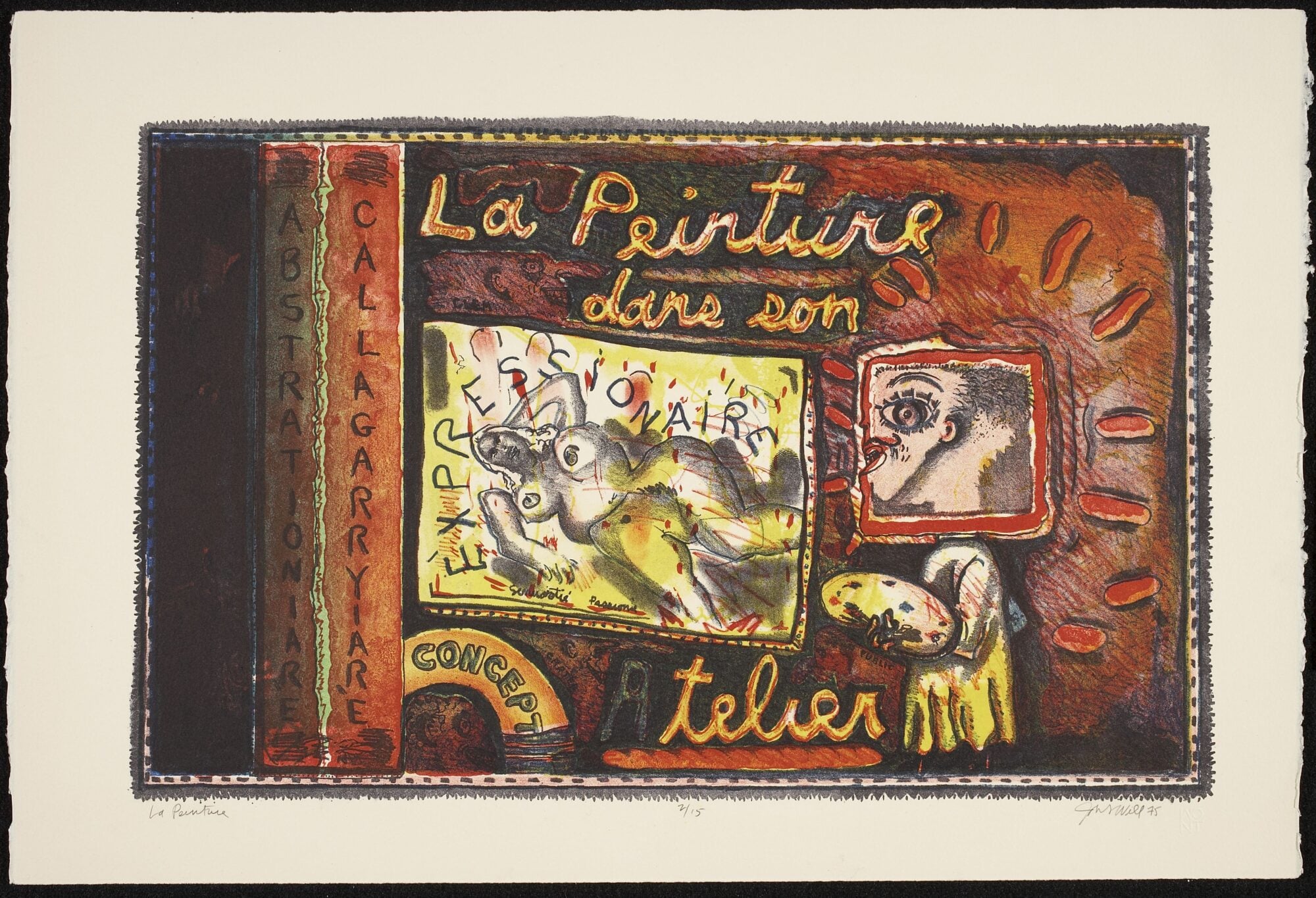
John Will arrived in Calgary in 1971, moving to the city to teach printmaking at the University of Calgary. A graduate of the University of Northern Iowa (BA, 1961) and the University of Iowa (MFA, 1963), he had also been a Ford Foundation Fellow at the Tamarind Institute, one of the most famous centres of lithographic printmaking in the United States. Will credited Tamarind with teaching him the process of lithography, and colour lithography was central to his practice in the 1970s. Many of the themes that he developed in this body of work remained constant foundations throughout his career. One of his earliest exhibitions of prints at Glenbow was held in 1975, and on that occasion Will offered a succinct statement about his approach to composition, humour, and texts, saying, “My approach to content is literal, and the largely autobiographical wit and caricature in my work keep it some distance from a ‘high art’ context. Colour and other formal devices become a ‘straight man’ for the comic, esoteric, pessimistic, or hysteric situations pictured. The words that occur in many of the prints are there to be read as well as to beef up the form. I believe that humour is a useful instrument to relax style. At times the style is so relaxed the jokes don’t have punch lines.”[1]
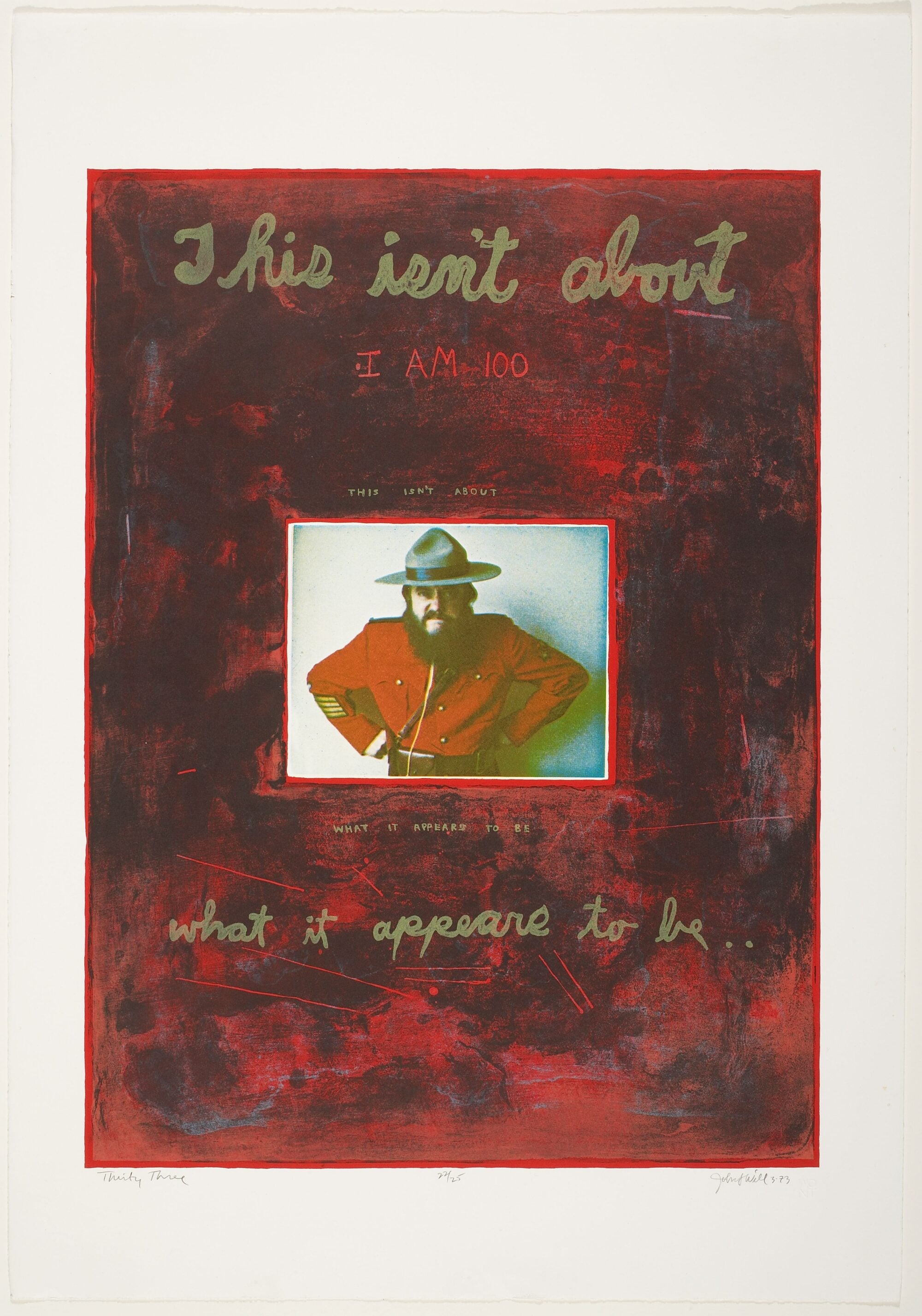
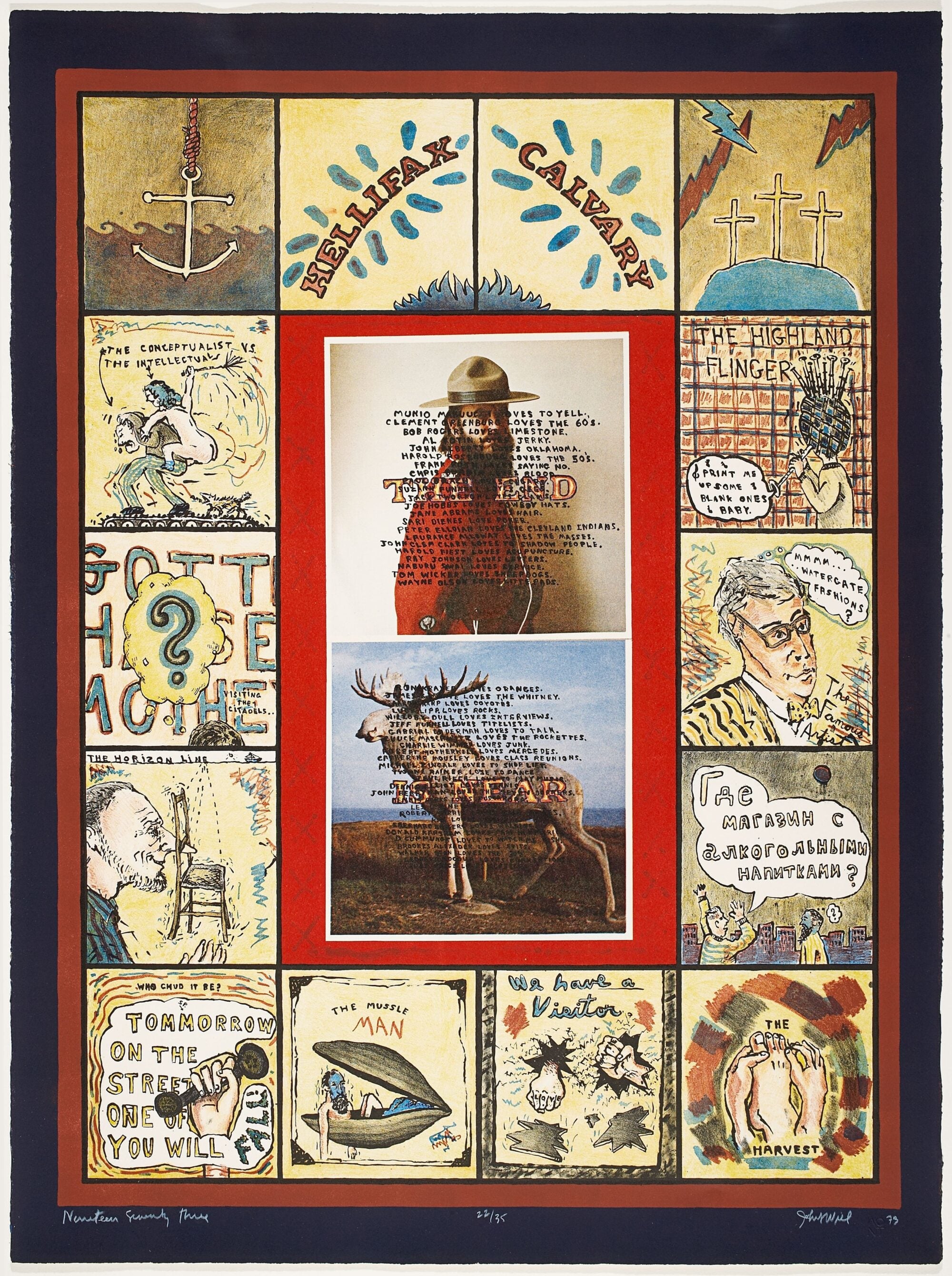
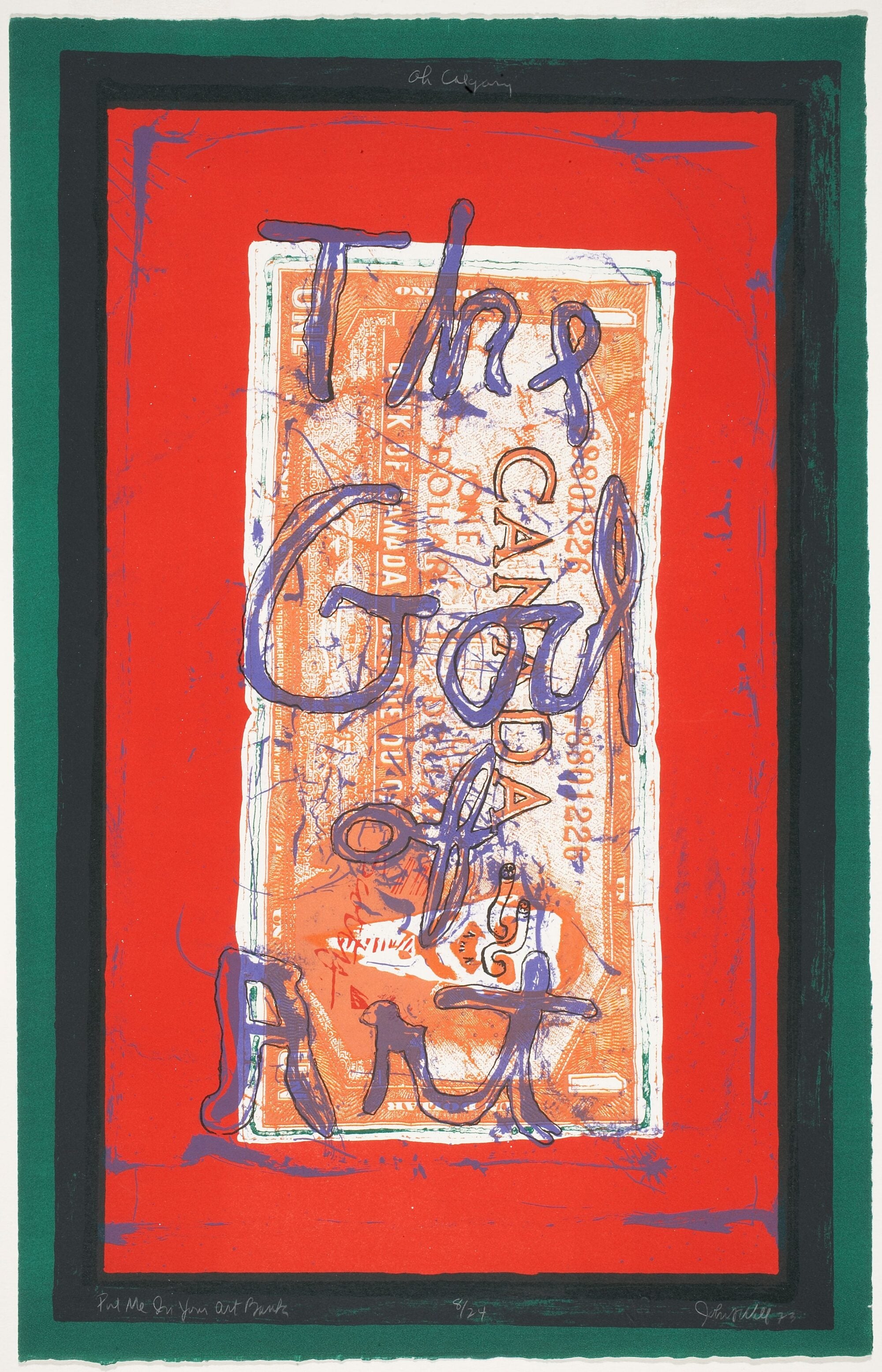
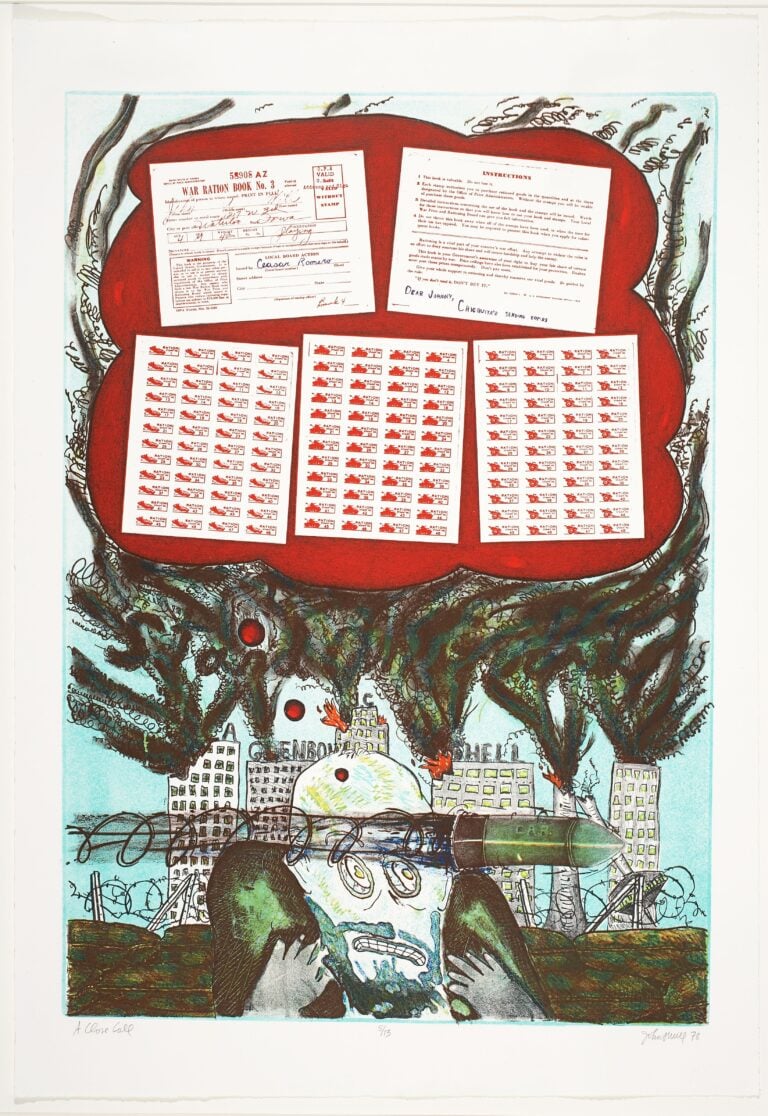
This early exhibition included several of Will’s most iconic prints, among them Thirty Three (1973), Nineteen Seventy Three (1973), and Oh Calgary, Put Me in Your Art Bank (1973). In these prints, we see Will’s ability to achieve wonderfully intricate details and rich patterns, but also his willingness to be playful and provocative. These prints demonstrate how Will placed his own experiences — and often his own image — in his art. As Will explained it in 1979, “My work having always been somewhat autobiographical led me into a series of works that are at least semi-self portraits utilizing events of my own environment.”[2] Each work offered many layers of meaning and colour; for instance, Thirty Three was created around the artist’s 33rd birthday and the 100th anniversary of the RCMP. This early body of work also shows Will offering a critique of the art community, another theme he would return to many times: for example, A Close Call (1978) includes several cultural institutions, including Glenbow. This print was featured in two major exhibitions at Glenbow that celebrated Will’s work in printmaking, a retrospective in 1980 and The Broken World of John Will in 2010.
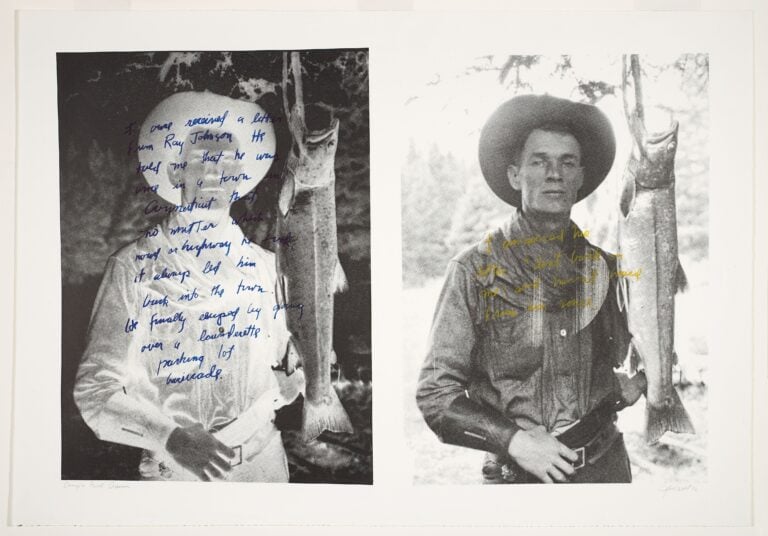
Will’s lithographs also reveal his interest in photography and photographs, as can be seen in the print Dougie’s Bad Dream (1972). Photography was a crucial part of his artistic work, both as a technique that supported his artmaking in other media (such as printmaking) and as a medium he explored in its own right. In 2018, Glenbow held an exhibition of Will’s work titled John Will: Photography R.I.P. — a title that reflected Will’s interest in analogue photography and how photography was changing in a new digital age. Photographs of all kinds have been important to Will’s art: as Nancy Tousley wrote, “Will exalts, questions and twists, at times with evident satisfaction, the whole notion of photographic truth. Taken out of context and without accompanying information, photographs and their contents are easily manipulated. They can be cropped, captioned, re-captioned, doctored technically, re-photographed, and juxtaposed with other photographs to change their meanings.”[3] Will worked with photographs in all kinds of ways, from creating his own series of black and white prints, such as Atomic Haiku (1994), to using found negatives to create new photo narratives, as in John and Lou’s 1923 Voyage (1997). But perhaps Will’s most famous work with photography was his integration of photographs into paintings.
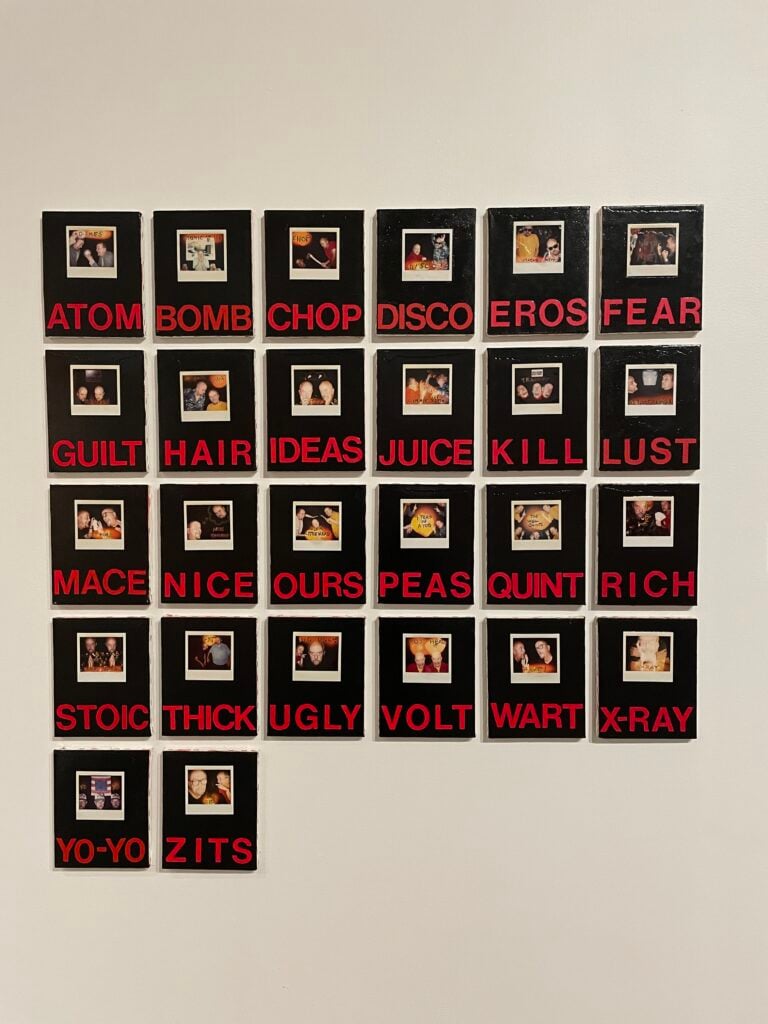
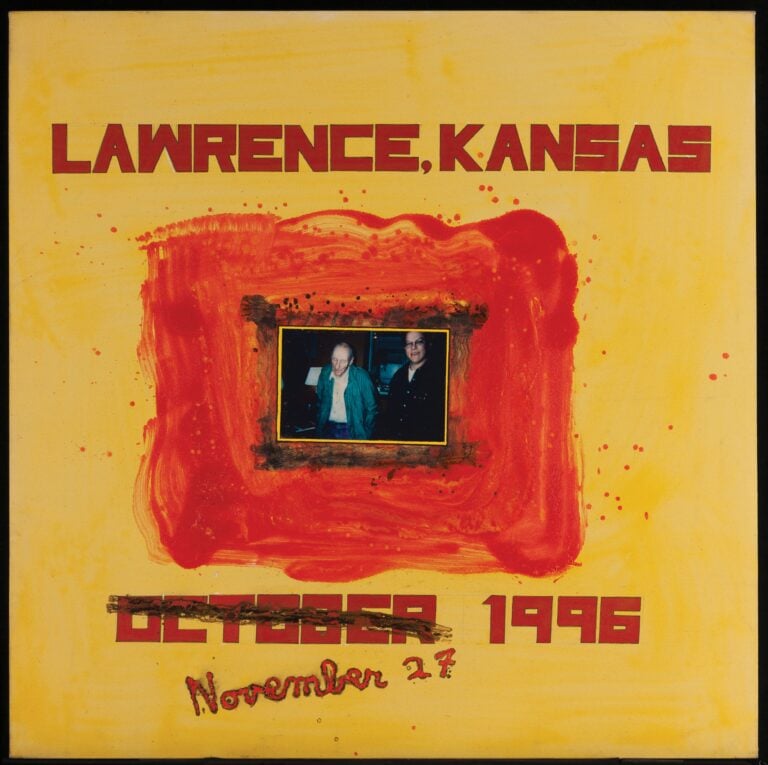
Artworks like Alphabet Series: A to Z (1995) and Lawrence Kansas (1996) demonstrate how Will’s early commitments to text, colour, and form played out in his later practice. For the Alphabet Series, Will created a canvas for each letter, applying a Polaroid photograph to each canvas (all of which feature photographs of Will himself) and juxtaposing the photographs with bold red words that form a startling, thought-provoking alphabet from Atom to Zits. In contrast, Lawrence Kansas centres on a single photograph, an image of Calgary artist Chris Cran meeting with American author William S. Burroughs. This work is dominated by the vivid contrast between the yellow ground and red texts and frame, and similar strong colours and texts would appear in many of Will’s paintings as well as later works on paper. Still, the anchor of Lawrence Kansas is the photograph of Cran, an allusion to the artist’s decades-long friendship with Will. Cran has appeared in many of Will’s paintings, and the two have collaborated several times. For instance, in one of their most celebrated projects, in 1989, with Dennis Hrubizna, they created the video Loved by Millions, which presents a satire of Cran’s art — and is another instance of how Will pointedly directed the artistic community to reflect on itself.
Right now, Alphabet Series: A to Z is on display in John Will: Born in the U.F.O—Some Truth, More Lies, All Legend, an extraordinary exhibition at the Art Gallery of Alberta that presents a dramatic survey of his career, bringing together prints, photographs, paintings, video, and works on paper. Seeing the many strands of Will’s art together reveals not only his talents in multiple media but also how the different threads come together. The humour of his self portrait prints is reflected in many later paintings; the poetic texts of his photo narratives are connected to the dynamic stories he told in videos; the sharp critiques in early work continued to appear in works he made in the last years of his life. Most powerfully of all, in over 50 years of making art in Calgary, Will kept his personal experiences at the heart of his art, and he filled his work with warm references to fellow artists, curators, critics, close friends, and family. In its entirety, his art represents his community, where Will has been an inspiring leader for many years, teaching and mentoring, supporting artists and arts organizations alike.
It’s hard to imagine the Calgary art scene without John Will, but his legacy is filled with art, ideas, and laughter that will stay with us in the months and years to come. Rest in joyous memory, John, and thank you for all the gifts you shared with our community.
References
[1] John Will, in Clyde McConnell, John Will / Marvin Jones (Calgary: Glenbow-Alberta Institute, 1975).
[2] Glenbow Archives, John Will Artist File, Artist Talk, 1979.
[3] Nancy Tousley, John Will: Photography R.I.P. (Calgary: Glenbow, 2018), 11.
