This summer, Glenbow was thrilled to welcome interns for the second year of the JR Shaw Institute for Art in Canada Internship Program. Funded through a generous donation from Shaw Family Foundation, this initiative was established to give students opportunities to work with Glenbow.
During this summer’s program, intern Jade Iwata had the opportunity to explore Glenbow’s expansive art collection and pursue a research project on printmaking in Canada. In this Q&A, she shares her research on artist Noboru Sawai (1931-2017), why Sawai’s prints resonate with her, and her experience of working behind the scenes with Glenbow.
What did you find most interesting about printmaking in Canada in the twentieth century?
What most interested me was how quickly experimentation in printmaking spread across Canada in the mid-twentieth century. Until the 1950s, printmaking was a specialized craft passed down through generations and brought to Canada by traveling artists. It was attractive to artists looking to capture their ideas with multiple editions of their work. As printmaking gained popularity, artists across the country began adapting traditional techniques in innovative ways.
Which artists have you focused on in your research, and why were you drawn to them?
For this project I researched seven artists, but I am most fascinated by Noboru Sawai (1931-2017). His approach to printmaking is unlike anything I’ve encountered before. When we first viewed his prints in the collection, I was immediately interested in how they were made and what inspired them. These questions guided much of my research.
Can you introduce us to one of the prints you’ve been studying? What stood out to you about this work?
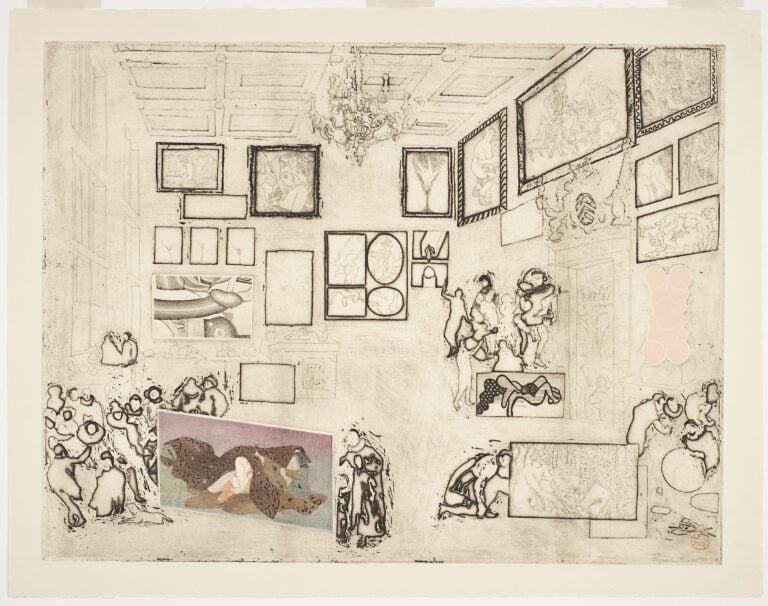
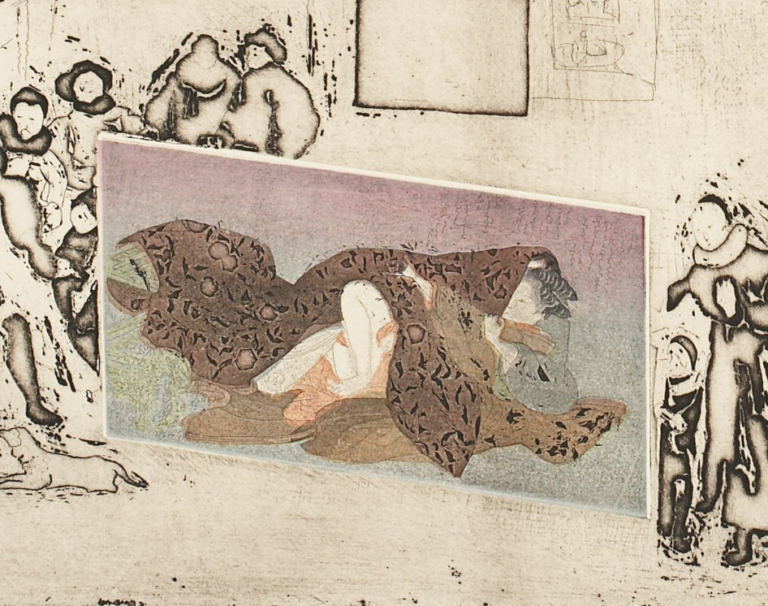
I would love to. Seen here is The Honorable Curator, created in 1974 by Noboru Sawai. It quickly became my favorite of the twelve prints covered in my research. It stood out because of its art historical references and intricate erotic imagery, which drew me in. The print showcases the aesthetic and techniques that Sawai is known for, including two distinct printmaking traditions — copper etching and colour woodcut — which he brings together in a single composition.
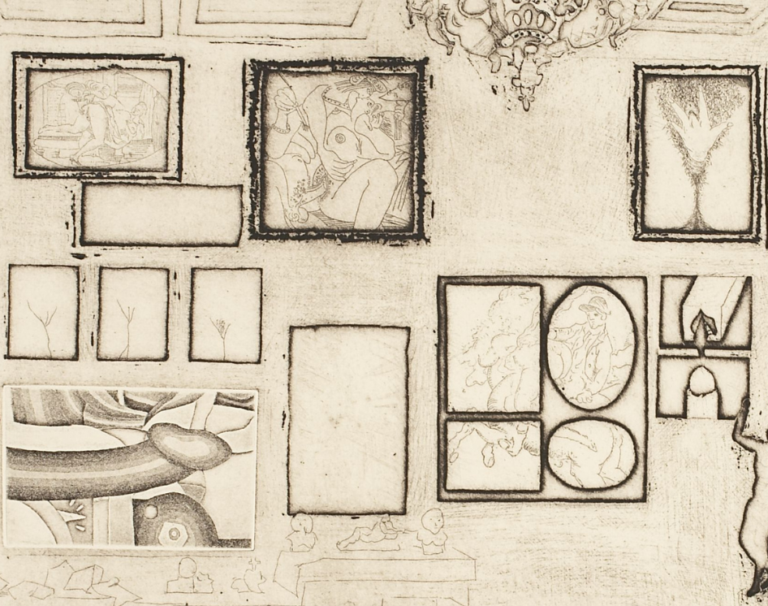
Sawai crosses cultural borders by combining erotic imagery from Eastern and Western art. In this print, he references traditional Japanese erotic prints, Hindu miniatures, pop art, and Picasso, among other art historical references. He then “exhibits” them in the style of a 19th century salon. In this gallery, boundaries, borders, and time are fluid and optional. Each frame invites viewers to consider who the gallery’s “honorable curator” might be and what questions they are asking about the value and position of erotic art.
What can you tell us about the printmaking techniques used to create the work you’ve selected?
Sawai’s prints are unusual in that they combine copper etchings and colour woodcuts on one print surface. Copper etching originated in Germany and involves chemically etching a design into the surface of a copper plate, filling the etched areas with oil-based ink, and then transferring the design to paper. Colour woodcut is a Japanese printing technique that involves carving away the negative space on separate blocks of cherry wood for each phase of colour and detail. Each block is inked with water-based colours and pressed onto long-fiber paper.
To combine an oil-based technique with a water-based technique — two materials that do not mix — was a significant endeavour. Rather than treating technical limitations as obstacles, Sawai approached them as an opportunity for exploration. As a result, he continually adapted his methods to achieve the exact composition he envisioned. In combining these techniques, Sawai also juxtaposes Eastern and Western aesthetics within his prints.
Sawai’s expertise in the field led him to teach printmaking at the University of Calgary for 22 years. He also founded Sawai Atelier in Vancouver – a publishing studio dedicated to combining intaglio and relief printing – which operated from 1981 until his death in 2016.
Prints are often thought of as images on paper, but they’re also physical objects with their own histories. How has studying the materiality of printmaking – the physical qualities of prints and the objects used to make them – changed the way you think about it?
The materiality and physicality of printmaking have fundamentally changed the way I understand the medium. Printmaking techniques were familiar to me before, but I had a limited understanding of each process. I have come to realize the term encompasses an extraordinary range of processes, materials, and artistic possibilities.
In my opinion, the labour required for each edition of a print cannot be simply described as reproducing a design. Through collaboration and human hands, a distinctness is created in each edition of a print that is unique to the medium.
You’ve had the opportunity to work behind the scenes with Glenbow’s collection. What has that experience been like?
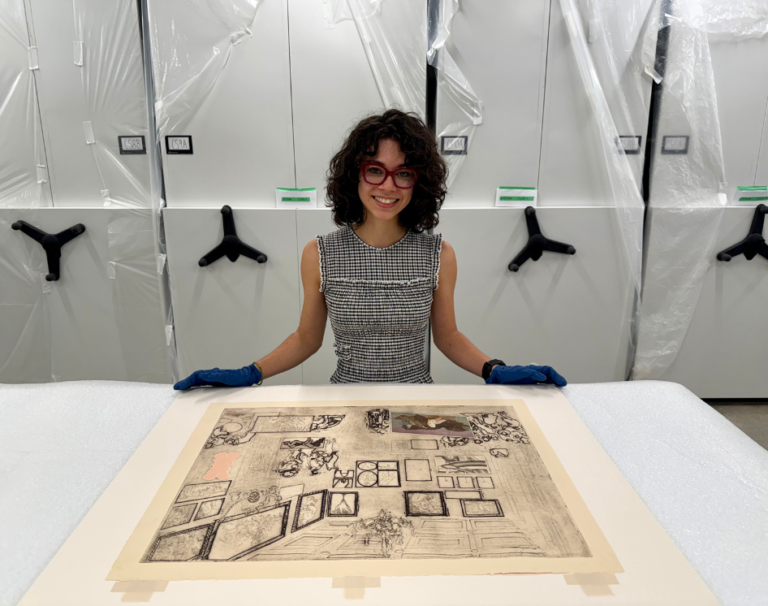
Working with Glenbow’s collection has been incredibly rewarding. Having the opportunity to work within the art collection has offered me a new appreciation for what art historical research can reveal. Seeing works in person revealed details that are not visible in photographs or through a screen, from inscriptions and markings on the reverse of an artwork to the subtle textures of the paper itself.
You also spent time exploring Glenbow’s extensive art library and archives. Did you make any interesting or surprising discoveries?
There were many surprising discoveries when exploring the art library and archives. Having access to Glenbow’s artist and source files when researching can reveal the larger story of an object or artwork. It also gives you a glimpse into an artist’s career that may not be accessible outside of museum archives.
The most surprising discovery I made related to Sawai’s The Honorable Curator was a Calgary Herald clipping from 1974 about an incident in which an edition of the print faced censorship right here at Glenbow. The article’s author, Carol Hogg, stated this was “the first publicized instance of art censorship in Calgary.” She details an incident in which a curator ordered the removal of the print from a group exhibition because of a visitor complaint about the print’s sexually explicit content. The Honorable Curator was removed from the exhibition after being on display for only two weeks.
This find was exciting because I was curious about the possibility of Sawai facing censorship due to the content of his work. Discovering this history within Glenbow’s own archives was particularly meaningful as it highlights how museums and cultural institutions continue to evolve, expanding how they interpret and present challenging works.
What are the biggest takeaways of your research at Glenbow this summer?
I have learned the value of studying artwork in person whenever possible. No photograph can fully capture an object’s scale, texture, or physical presence. While this is not always possible, those qualities are essential to understanding the work itself.
My biggest takeaway is just how much there is still to discover. In ten weeks, we only scratched the surface of Glenbow’s print collection, and there are countless stories still to be explored.
