Glenbow celebrates its 60th anniversary this month!
Over the past six decades, Glenbow has grown into one of Western Canada’s most beloved and impactful cultural institutions, connecting generations of visitors with art, culture, history, and the many voices that shape this place.
Throughout the month, we’ll be marking the anniversary with a special series on our blog exploring Glenbow’s origins, its evolution, its collections, and what’s next. To kick things off, we’re looking back at Glenbow’s founding and the life and legacy of Glenbow’s founder, Eric Lafferty Harvie.
Eric Lafferty Harvie’s Vision
Glenbow began with the remarkable vision of entrepreneur and lawyer Eric Lafferty Harvie (1892-1975). Harvie was born in Orillia, Ontario and moved to Calgary in 1911, where he completed his studies, began his legal career, and pursued business opportunities in the new province of Alberta. His early adulthood was interrupted by the First World War, in which he served overseas – in 1916, Harvie was wounded in action in the Battle of the Somme in France. After recovering from his injuries, he returned to Canada and was eventually discharged. He married Dorothy Southam and together they had three children: Joy, Donald, and Neil.
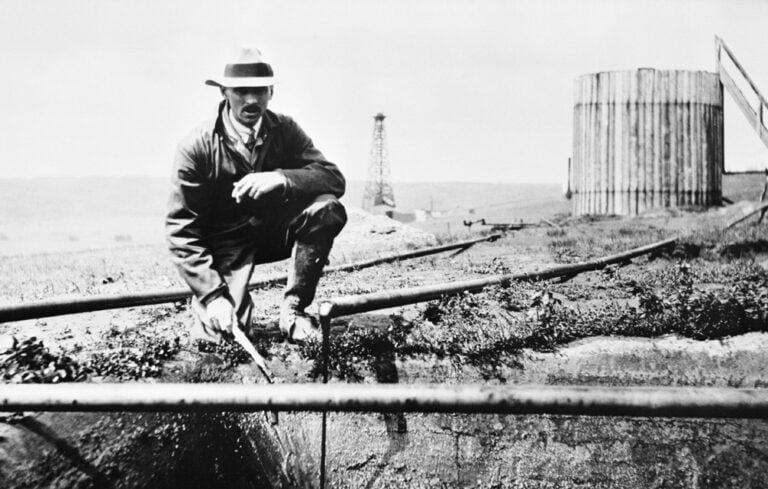
In Alberta, Harvie became increasingly involved in business ventures, including managing companies and acquiring land. Among these holdings was Glenbow Ranch (today known as Glenbow Ranch Provincial Park) – Glenbow’s namesake – which served as a working ranch and a retreat for the Harvie family. Harvie eventually established his own law firm and a management company, overseeing a range of business interests.
Harvie was especially interested in the oil industry and invested strategically in mineral rights before major discoveries were made. His investments paid off when oil was discovered on land to which he held mineral rights, including in Leduc, Alberta in 1947 and in Redwater, Alberta in 1949. With this prosperity, he chose to pursue his passion for collecting while also returning some of his good fortune to the region through philanthropy and the creation of cultural institutions.
Building the Collection
Eric Harvie created the Glenbow Foundation in 1955 to house and develop his growing collection. This included artworks, natural history specimens, photographs, documents, and cultural belongings. He was particularly interested in the history and culture of Western Canada, though as his staff at the Glenbow Foundation grew, so did his collecting from other parts of the world.
Harvie’s collecting process was ambitious and sometimes unconventional. He hired a small but dedicated team of curators, historians, and field collectors, instructing them to gather material that documented the story of the West. The team travelled across communities in the region, collecting systematically as well as through relationships, word of mouth, and chance encounters.
At the same time, Harvie collected on a global scale. Through personal travel and a growing network of dealers and collectors, he acquired objects from around the world. He was known to purchase entire collections in bulk, from private collections to museum holdings and artist studios, resulting in rapid growth. By the early 1960s, the Glenbow Foundation had accumulated a large and wide-ranging collection spanning history in Western Canada and internationally.
Creation of the Glenbow Museum
In 1966, Harvie’s vision reached a new milestone when the Glenbow-Alberta Institute Act created the Glenbow Museum – an official home for his vast collection. This founding included Harvie donating his collection of art and objects to the people of Alberta, along with a $5 million endowment to create and sustain the museum. This endowment was matched by the Alberta government.
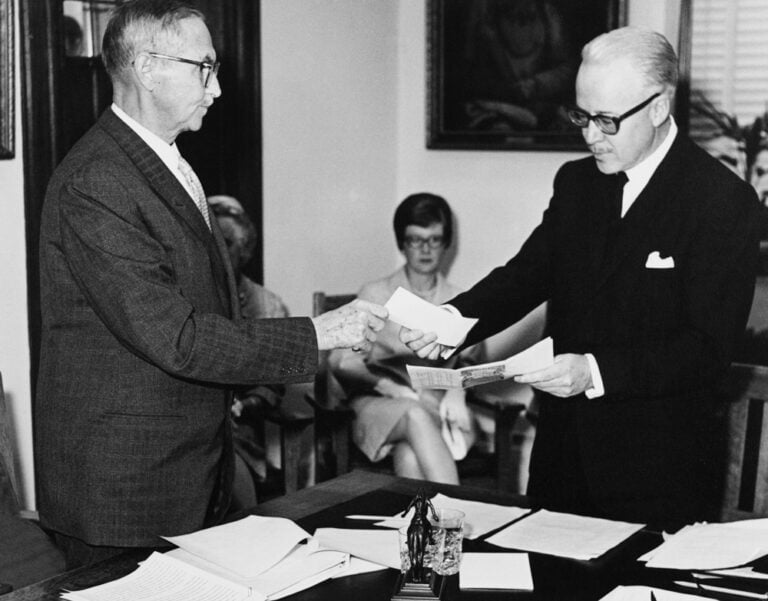
The creation of the Glenbow-Alberta Institute ensured the long-term preservation of the collection, which had become increasingly important to Harvie. He remained closely involved in shaping the museum’s collections in the years that followed. The museum operated out of 10 locations across southern Alberta until the opening of its purpose-built building in 1976 – in the coming weeks, we’ll explore more about these locations and Glenbow’s evolution since its founding.
Today, Glenbow carries forward Harvie’s belief that connecting visitors with collections of art, objects, and belongings fosters a deeper understanding of place, identity, and community. As Glenbow prepares to reopen with a welcoming new experience in its revitalized home, the JR Shaw Centre for Arts & Culture, Harvie’s legacy continues to live on. Here’s to the next 60 years!
