This summer, Glenbow was thrilled to welcome interns for the second year of the JR Shaw Institute for Art in Canada Internship Program. Funded through a generous donation from Shaw Family Foundation, this initiative was established to give students opportunities to work with Glenbow.
During this summer’s program, intern Ella Tang had the opportunity to explore Glenbow’s expansive art collection and pursue a research project on printmaking in Canada. In this Q&A, she shares her research on Inuk printmaker, illustrator, and sculptor Kananginak Pootoogook (1935-2010), why Pootogook’s work resonates with her, and her experience of working behind the scenes with Glenbow.
Hello, Ella! What did you find most interesting about printmaking in Canada in the twentieth century?
What is most interesting to me about printmaking in Canada during this time is the variety of lived experiences that influenced artists and shaped the diversity of approaches and subject matter that informed the prints they made. While printing was part of some artists’ practices, others collaborated with print shops and master printers. I found there was no shortage of works to explore, especially since printmaking encompasses so many different techniques.
Which artists have you focused on in your research, and why were you drawn to them?
One artist I became interested in was Inuk printmaker, illustrator, and sculptor Kananginak Pootoogook (1935-2010). His work in printmaking was extensive; he printed in numerous mediums including stonecut, stencil, and lithography, including art he designed himself. What initially caught my attention about Pootoogook’s body of work was its range, including prints made from drawings by his father and scenes that captured his own lived experience.
Pootoogook was involved in the Kinngait Co-operative from its inception, where he was the organization’s first president and one of its original printers. The Kinngait Co-operative was established to support the production and marketing of Inuit art, with its Kinngait Studios becoming a renowned centre for drawing and printmaking. Both the Co-operative’s history and Pootoogook’s life reflect Inuit resilience as Kinngait adapted to a changing economy and new forms of artistic production, including printmaking.
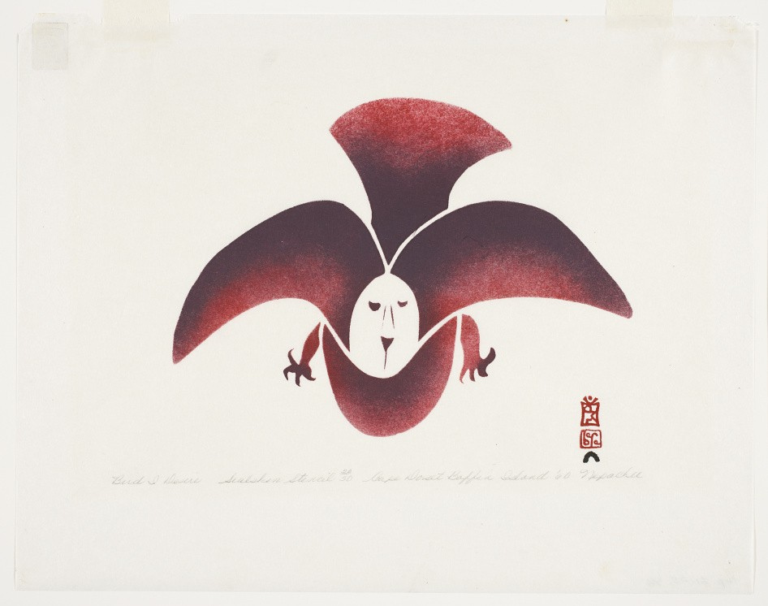
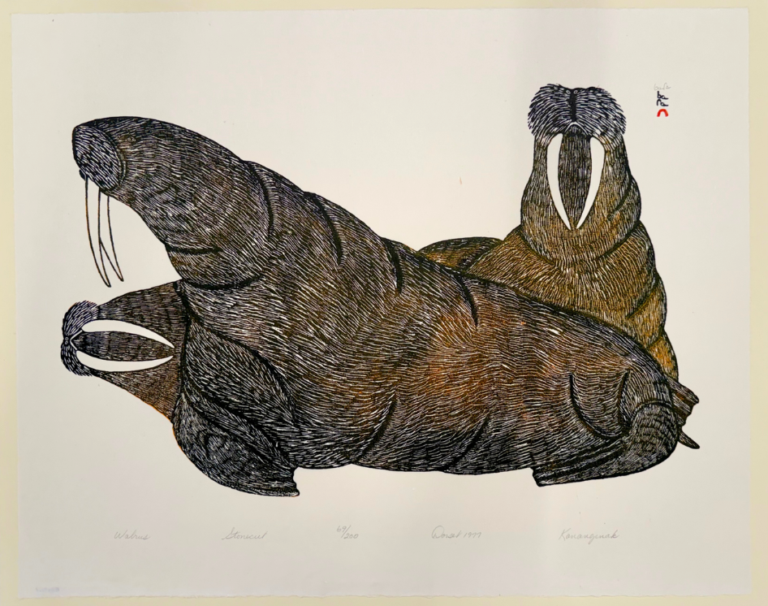
Can you introduce us to some of the prints you’ve been studying? What stood out to you about these works?
Of course! Seen here are two prints Pootoogook was involved in making, produced nearly two decades apart. Bird I Desire was printed by Pootoogook from art made by Napachie Pootoogook. This print was created in 1959, in the early years of the Kinngait Co-operative. At the time, James Houston (who co-founded the Co-operative with Pootoogook) had recently returned from studying printmaking in Japan and was intent on promoting many of the techniques he learned.
My favourite detail about this print is the artist and printer’s name chops (a seal or stamp used to “sign” the work), intentionally stylized to resemble Japanese name stamps with Inuit syllabics. Although this stylization was not used for very long, it demonstrates how outside influences were adapted and shaped in new ways.
I chose Walrus because it highlights Pootoogook’s artistic abilities. His skill in depicting wildlife with an exceptional level of anatomical accuracy is often credited to his knowledge as a hunter. Beyond the physical form of the walruses, what stood out to me about this print was the expressiveness of the animals.
This print is also a testament to the wider recognition that Pootoogook’s work went on to receive, as it was made as part of a larger print portfolio commissioned by the World Wildlife Fund. Their logo in the form of a chop is noticeable on the work.
Taken together, this pair of prints provides a sense of Pootoogook’s skill both in drawing and in making prints.
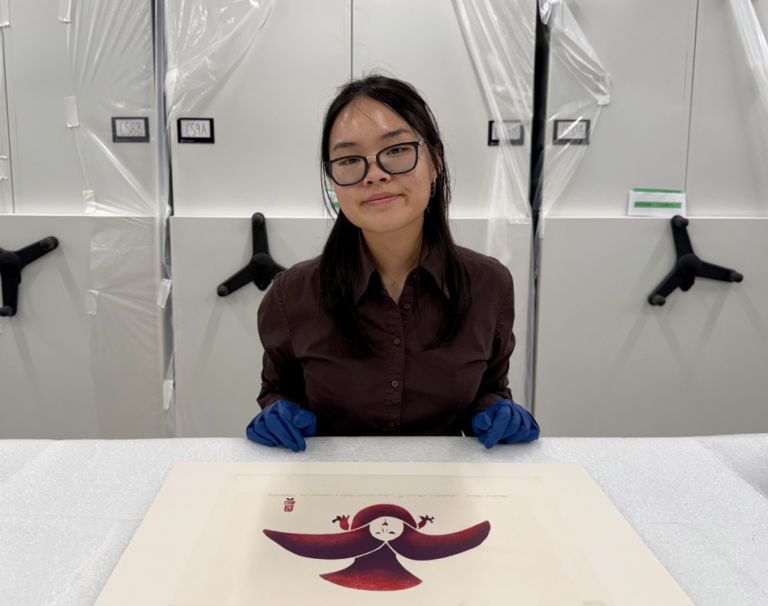
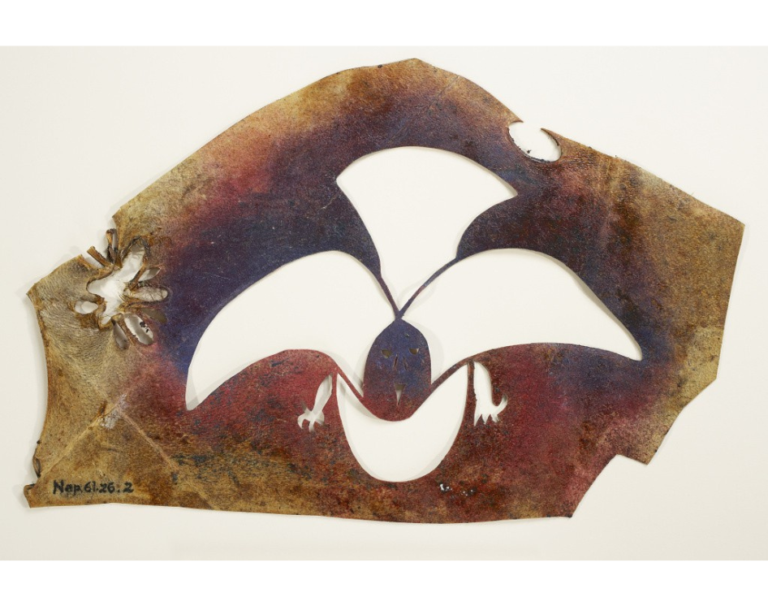
What can you tell us about the printmaking techniques used to create the works you’ve selected?
Bird I Desire and its sealskin stencil capture a unique part of Kinngait Co-operative’s early printmaking history. The use of sealskin stencil appliqué can be linked to a much longer tradition of use by Inuit women. It was briefly used as an experimental method for printmaking, though it was only used for proofs (test prints) and ultimately replaced by stencil plates made from waxed paper. Pootoogook, in this case, would have made both the sealskin and waxed paper stencil, as well as applied the ink for the prints. In his role as printer, he would have had significant input on the colour selection for the print, too.
Walrus was made using stencil and stonecut – a method that uses printing blocks made of soft stone carved with the image that is to be printed. Not only would carving a design with so many precise lines have required significant time and expertise, but the process of creating the block involved great physicality.
Prints are often thought of as images on paper, but they’re also physical objects with their own histories. How has studying the materiality of printmaking – the physical qualities of prints and the objects used to make them – changed the way you think about it?
When we first began our research project, fellow JR Shaw Institute for Art in Canada intern Jade Iwata and I discussed how the concept of reproducibility is a key part of printmaking. I’ve really come to appreciate how this quality allowed artists to make a living. From a research perspective, looking at multiple editions and trial prints was informative of how artists worked.
Being able to take a closer look at the colour and size of prints and print blocks has given me a greater appreciation of artists’ works. Considering the entire process of printmaking puts into perspective the intensity of labour and time required, because it includes everything from planning and drafting designs to making and testing the print. Something I hadn’t realized until seeing the prints in person was how much the printing method could influence the size of the work. For example, many of the wood engravings were smaller than the silkscreens that we encountered.
You’ve had the opportunity to work behind the scenes with Glenbow’s collection. What has that experience been like?
One of the most valuable parts of working with Glenbow’s collection has been exploring prints in person. It’s been a privilege to have worked in the new collections spaces, from browsing screens of paintings to moments of discovering unexpected prints when looking through storage boxes. Experiencing the vast number of artworks, objects, and belongings in person has left me with a stronger connection to the collection as a whole.
You also spent time exploring Glenbow’s extensive art library and archives. Did you make any interesting or surprising discoveries?
It’s been fascinating to dive into artist fonds and read through newspaper clippings, ephemera from exhibitions, and even interview transcripts. Since much of this material is not available digitally, working in the archives has been integral to researching the lives of many artists. Reading materials written by the artists themselves has been very valuable, and I have a distinct memory of finding copies of letters between artists Cecil Buller and Randolph Hewton. Although not directly relevant to my research project, in this case Buller’s connection with Hewton offered a rare glimpse of her own words.
What are the biggest takeaways of your research at Glenbow this summer?
One takeaway for me came from learning about the unique ways of printing that artists explored, such as using experimental materials or trying to replicate effects achieved in other mediums. This expanded my understanding of printmaking, specifically in thinking about the capabilities and freedom of expression it can offer.
Another takeaway from this project was seeing the value of “slow” work: revisiting exhibition catalogs and articles, returning to artworks with greater background information, and taking the time to consider the details, both visible and not. This wouldn’t have been possible without the chance to work in the archives and collections, and it has been a wonderful opportunity.
